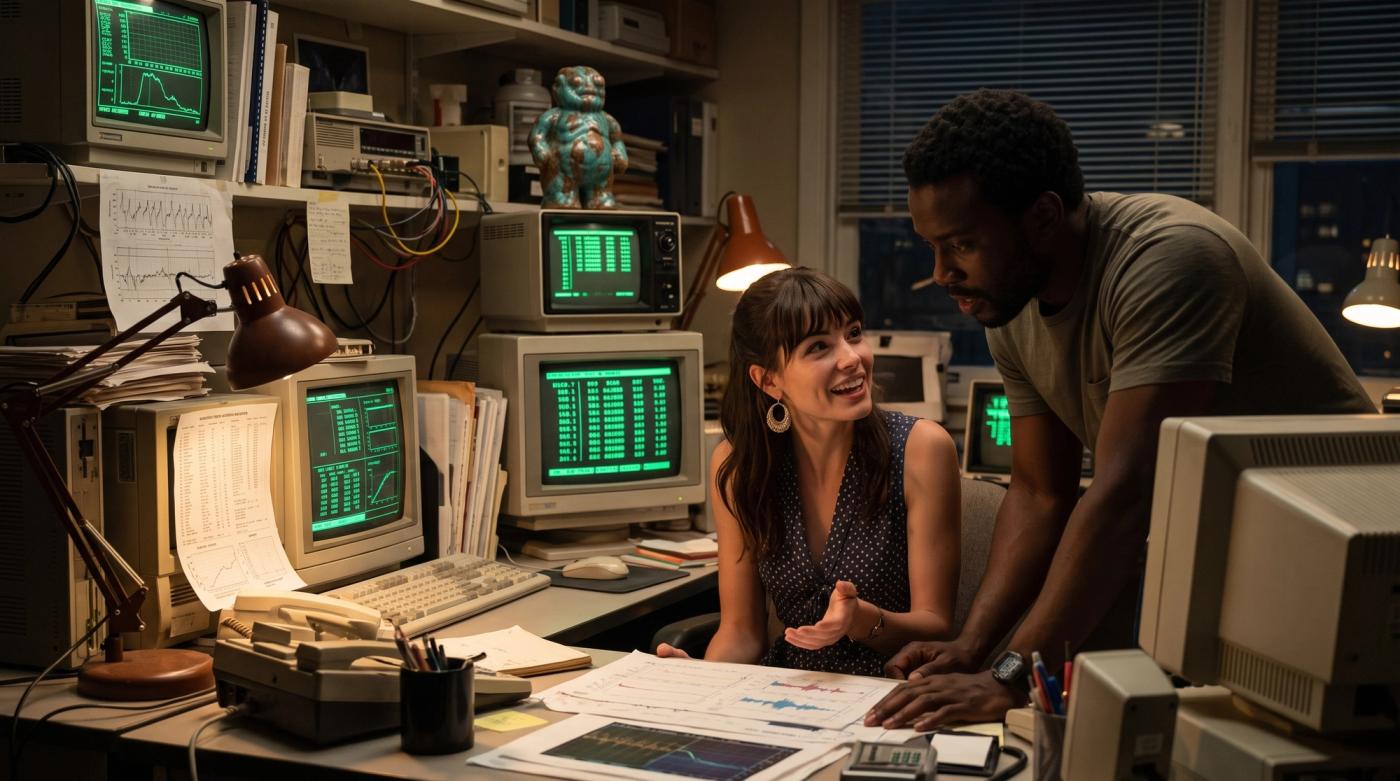
Marcy Wagner had sold the house, the car, both couches, and a garden she'd spent nine years getting exactly wrong, and what she had left fit under the seat in front of her: two bags, a thermos, and Rupert, who was not enjoying himself.
"He'll settle," she said, to no one in particular, and then, because the man beside her had clearly been about to ask, "Cat."
Steve nodded like a man who'd already decided not to make this flight longer than it needed to be. He had the window. She had the aisle and, apparently, the next several hours.
Outside, Earth did the thing it did now, hanging there getting smaller, and Marcy found she felt about it the way you feel about a house you've sold to good people — fond, finished, not tempted to knock. She'd bought the flat on Mars without seeing it. Sight unseen felt right, somehow. It was the family style.
"First time?" Steve asked, meaning Mars.
"Something like that," she said, and settled Rupert's carrier more firmly between her feet, and thought, not for the first time, that this was probably as good a captive audience as she was ever going to get.
"You want the whole thing," she said, "or just the parts that are true?"
He said he had nowhere to be.
"Good," she said. "Then I'll start with the woman who lost her keys."
—
Jackson Tremont lost her keys on the way to the office. They had slipped somewhere near the grass by her car, but she didn't notice. The morning air was cool, a bit dewy. She pulled her jacket tighter around her shoulders as she walked across the parking lot, juggling her tote bag and her coffee. She was halfway up the sidewalk when she thought about the spreadsheet she hoped she saved.
"Morning, Bob," she chirped at the oversized Roomba mopping the observatory entrance. A few visitors milled about outside, waiting for the place to open.
Jackson reached the back office. "Morning, Luis." He waved without looking up. "Everything ready for today?" she asked, dropping her bag onto the chair.
Luis shrugged. "Usual. Want a bagel?" Luis loved a crispy morning bagel, always had spares. Jackson wasn't a bagel girl. She scanned the schedule board, making mental notes of who was on what and what was on who.
Rafi poked his head through the doorway. "You remember the school group this morning, right?"
Jackson groaned. "The what?"
He pointed his thumb toward the lobby. "They're early. Like, before coffee early."
He went back to fussing with the projection equipment, which was already sulking in its usual way — half the filters refused to load, and the audio was stuck on a faint background hum that sounded like whale song.
Maya floated in carrying a squat, lumpy figurine — something between an angel and a toaster. The glaze had run in strange streaks of turquoise and rust.
"Look what I found," she said. "Mondriam Monastery. One of the residents made it. They were having a sale to fund a labyrinth expansion."
Luis squinted. "That's from a monastery?"
"It's like a commune for the enlightened," Maya said, setting the figure on the counter beside the old oscilloscope. "South of Santa Fe. Retired physicists, yoga teachers, people who talk to light."
Rafi grinned without looking up. "Do they offer gullibility discounts?"
Maya ignored him. "The artist said this one represents the 'intersection of humility and voltage.' I think it brings the room balance."
Luis turned back to the console. "Yeah, we could use some balance. And some voltage."
The projection system whirred and coughed; Rafi gave it a light smack. Jackson was getting mentally prepared for the onslaught. The figure watched with a ceramic eye. Or whatever that was.
Luis looked up from his screen. "Does it hold coffee?"
"Negative energy," Maya said, moving it to a shelf between a stack of printouts and a box of spare cables.
Out in the dome, the first wave of children poured in, their teacher trying to maintain authority with the voice of someone who had already lost the battle. Jackson adjusted her badge and went to meet them.
Behind her, Luis frowned at the telemetry feed. Something on the outer sensor array was blinking at irregular intervals. He watched it for a few seconds, decided it was a software hiccup, and made a note to check it later.
Jackson put on her best educational smile. The kids were a swarm of sneakers and sticky fingers, orbiting the exhibits like sugar-fueled satellites.
"This," she said, gesturing toward the main display, "is where we look at things very far away."
A small boy raised his hand. "Like Albuquerque?"
Close enough.
Behind her, Rafi and Luis kept their eyes on the telemetry screen. Every few seconds, one of the outer sensors blinked out of sync. Luis muttered something under his breath and adjusted a setting.
The projection flickered — a brief static pulse across the dome, like a heartbeat. Jackson pretended not to notice.
"Okay," she said brightly. "Now who wants to see how stars explode?"
Half the group cheered; the other half ran toward the vending machine.
The school group had been a blur of chatter and sneakers. Jackson moved through her practiced routine: constellations, star births, the myth of Orion, half of it muscle memory by now.
Rafi managed the projection from the booth, doing his best to keep the kids entertained when the dome lights flickered. Luis muttered to himself over the console, running diagnostics that didn't quite make sense.
Halfway through the segment on exoplanets, the feed from the main array popped onto his auxiliary screen. A pale line of light drifted across the grid, slow, off-axis.
"Luis," Rafi whispered, leaning over.
Luis didn't look up. "Later."
"I think it's—"
"Later."
Down below, Jackson was explaining how ancient sailors used the stars for navigation. She could feel the teachers tensing, could smell the sugar that was literally everywhere. A kid raised a hand.
"Are we lizards? My dad says we are lizards."
Jackson blinked. "Not yet," she said.
Maya drifted in near the end, clutching a mug of tea, humming something about cosmic harmony.
When the bus finally left, Jackson leaned against the railing. "Next time," she said, "I want hazard pay."
Luis was already back at the console, tapping through data streams. "It's not just the usual noise," he said. "These pings — look at the pattern. It's too regular to be random."
Rafi leaned in, squinting. "Could be a satellite?"
Luis shook his head slowly. "Not a satellite," Luis said. "Wrong altitude, wrong speed, and it just changed direction. Satellites don't do that."
"It's been holding this pattern for twelve minutes," he said.
Jackson set down her clipboard. "Weather balloon?"
"Wrong altitude," Luis said. "Wrong speed. Too thick for orbital debris. And it's wobbling."
"Wobbling?"
Luis zoomed the feed, squinting. The shape thickened, blurred slightly, then steadied again — a long, dull glint, like metal seen through heat.
"Yeah," he said. "Not a satellite."
The blinking resolved into a tight cylindrical formation, moving far too fast. The room went quiet except for the soft hum of the servers. Rafi's eyes were wide, half thrill, half disbelief.
Jackson folded her arms. "So what is it?"
Luis leaned back in his chair, exhaled.
"Sweet mimini from Bimini," he said. "That's an alien spacecraft."