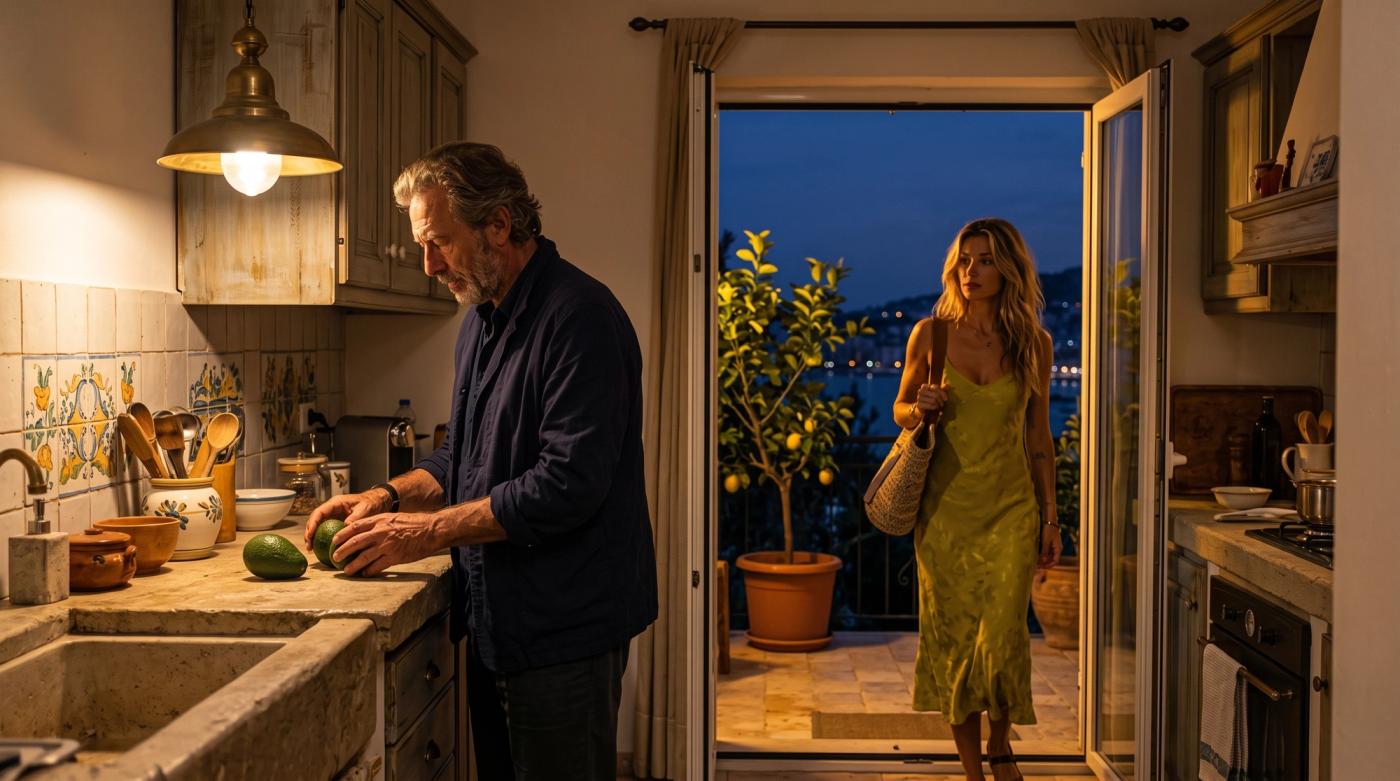
The avocados were the problem.
Albanian avocados were not the problem exactly — they existed, they were available, they were even reasonably priced — but they had the disconcerting quality of having been picked three days early. Two were currently on the window sill, somewhere between not-yet-ready and never-going-to-be-ready.
I was analyzing two new candidates — testing the give, neither convincing — when she walked in.
I knew before I turned around completely. The register in the market changed. The way a room changes when someone who takes up their full allotment of space arrives in it.
The highlights. The promenade. The afternoon light. Now in the market with a canvas bag over one shoulder and the forward momentum of a woman who had never entered a room without a plan.
She saw my hands. The avocados.
“Oh,” she said, in English that had been thoroughly throttled by French before arriving. “You are making something good.”
Not a question.
“Tacos,” I said. I had not decided to say this. The filter system had not been consulted. Tacos simply arrived in the air between us and attached themselves to my voice and there was nothing to be done about it.
She looked at me. Then at the avocados. Then back at me.
“I am coming,” she said. “What time?”
I stood at the counter with my goods as I watched the thing unfold. “Eight,” I blurted, wondering if I were in an Albanian market cosplay.
“Seven-thirty,” she said, already moving toward the produce. “I will bring wine. Albanian wine — you know it? No? You will know it tonight.”
I watched her discuss tomatoes with the market woman in a clipped Albanian, that of someone who had learned it phonetically and deployed it with absolute confidence regardless of accuracy. The market woman appeared to find this acceptable.
I paid for my avocados. Selected the two least committed to being wrong.
“You are up the hill?” she said, without looking at me. She already knew.
“Rruga Kali,” I said.
“Yes. I know the house. The old couple. She is Greek.” She picked up a tomato, approved it, dropped it in her bag. “I am Chartreuse.”
“R,” I said.
She looked at me properly for the first time. The highlights in the market light doing what they did.
“R,” she repeated, as if tasting it. “Bien. Seven-thirty, R. Don’t overcook the meat.”
She was already at the door.
“I don’t —” I started.
Gone.
The market woman looked at me like she had seen Chartreuses before. I put two limes in my bag.
The walk up from Sarandë to Gjashtë felt different than usual. The hill maintained its position on the matter.
I came through the gate past the roses.
Ori was finishing in the garden, moving toward the lower door with the unhurried economy of a man whose day was completing its mission. He looked at me. Looked at the bag. Said something in Albanian that my vocabulary of fourteen Albanian words couldn’t process.
“Tacos,” I said.
Ori considered this. Nodded once, as if “tacos” was a reasonable explanation for whatever. Went inside.
It was 7:24 and I was upset with myself.
The tacos smelled good. That was the problem. I had wanted to eat them alone, standing at the counter, looking out the window at the lemon tree in the evening light, not talking to anyone.
I had the cilantro. I had the limes. I had the avocados, which had in the heat of the kitchen made a late decision to be adequate. The meat, lamb, because Albania, seasoned correctly, resting.
The apartment looked the way it looked. I had done nothing about this.
Seven twenty-five.
I heard her before the knock. Footsteps on the outside stairs with an unhurried rhythm, certain, the rhythm of the decided, who knew where they were headed, now simply completing the journey. The knock was not a knock so much as a notification.
I opened the door.
Chartreuse stood there with a bottle of Albanian wine in each hand and the glint of a woman who knew doorways to be transitions not terminals.
“The gate was open,” she said, moving past me. “The old man was in the garden. We spoke.”
“You spoke to Ori.”
“A little Albanian, a little Greek. His wife came out.” She set the wine on the counter with the decisive placement of someone arranging an exhibition. “She is suspicious of me. This is normal. She is suspicious of everyone.”
She looked at the tacos.
“Oh. These are good. I can see already.”
“You spoke to Ori’s wife.”
“She warmed up.” Chartreuse was already examining the apartment in the comprehensive way that French women examine rooms — not intrusively, just completely. Taking inventory without apology. “This was the daughter’s?”
“Yes.”
“She went to Athens.”
“Yes.”
“Everyone goes.” She found the wine opener before I knew she was looking for it. “Athens, London, Milan. They all go. This is Albania’s tragedy and also its secret.” She pulled the cork. “The ones who stay are the interesting ones.”
I found two glasses.
“And you,” she said, pouring. “Why do you stay?”
“I haven’t stayed. I have a year lease.”
“Same thing.” She handed me a glass. Raised hers. “To tacos in Albania. This is not a thing that should be. Yet here we are.”
I drank. The wine was dark and slightly wild with strong feelings about where it came from.
Chartreuse: “Drink. I will tell you about Sarandë while you cook. You don’t know anything yet.”
“I’ve been here three months.”
“Yes,” she said, settling onto a stool with the ease of someone who had established residency in thirty seconds. “Nothing.”
She ate tacos the way she did everything — with complete commitment and running commentary. The lamb was good, she said. The avocados were almost there. The cilantro was correct. She knew who grew it but didn’t say how she knew.
The Sarandë social scene she dispensed in twenty minutes. I listened to all of it. There were the Germans who had bought a restaurant and were learning that running a restaurant and eating in restaurants were different skills. There was the British couple who had been there four years and had opinions about everyone who had arrived after. There were the Albanians who worked in tourism, and some who owned the touristy spots, and some who resented both. There was a Russian who claimed not to be Russian. There was a woman from California who opens chakras and was writing a memoir and would exhaust you with both if you gave her any opening at all.
I filed all of it under things that existed.
“You should come to the Tuesday thing,” Chartreuse invited.
“I won’t.”
She looked at me. Assessed. Heard it before, grants it marginal respect.
“What do you do?” she said.
I told her. The writing. The music. The websites.
“The websites,” she said, sitting up. “You build them yourself?”
“Yes. Let’s say I’m learning. You know vibe coding?”
And she did. For thirty-five minutes, with the same energy she brought to everything, Chartreuse explained vibe coding — the prompting, the iteration. No code. Just conversation with a system that needs you to know what you want.
I listened with the attention I gave to things that were actually useful.
She pulled out her phone, showed me examples. Walked me through the logic. Corrected herself twice, which meant she actually knew what she was talking about. Made me repeat the key steps back to her, which I did, because she was right to make me.
“This is how I built my shop,” she said. “Three days. No developer. My developer was terrible anyway.”
I thought about my websites. The ones I was building the long way.
“Send me the prompts you use,” I said.
“I will send you everything,” she said, already typing. “You will thank me. Not now. Later. When it works.”
She finished her wine. Stood with the decisiveness of a woman whose evening had a concept and had completed it.
“The tacos were good,” she said. “The avocados were almost there.”
“You said that already.”
“It is still true.” She looked at the apartment one more time — the inventory complete, filed away for purposes I couldn’t guess. “You are good here,” she said. Not a question. Not exactly a compliment. An assessment delivered without sentiment.
“Yes,” I said.
“Good.” She moved to the door. “The old couple. They like you.”
“How do you know.”
“She told me.” Chartreuse opened the door. “Her Albanian is better than mine. Don’t tell her I said that.”
She was gone.
The footsteps on the outside stairs, certain, unhurried, fading toward the gate.
I stood in the apartment. Two empty wine bottles. The taco situation resolved. The window still open, the lemon tree in the dark beyond it.
I looked at my phone. Chartreuse had sent three links and a voice memo of herself explaining the prompting sequence in French-inflected English at the speed of someone who did not believe in wasting the listener’s time.
I listened to it twice.
Then I opened my laptop.