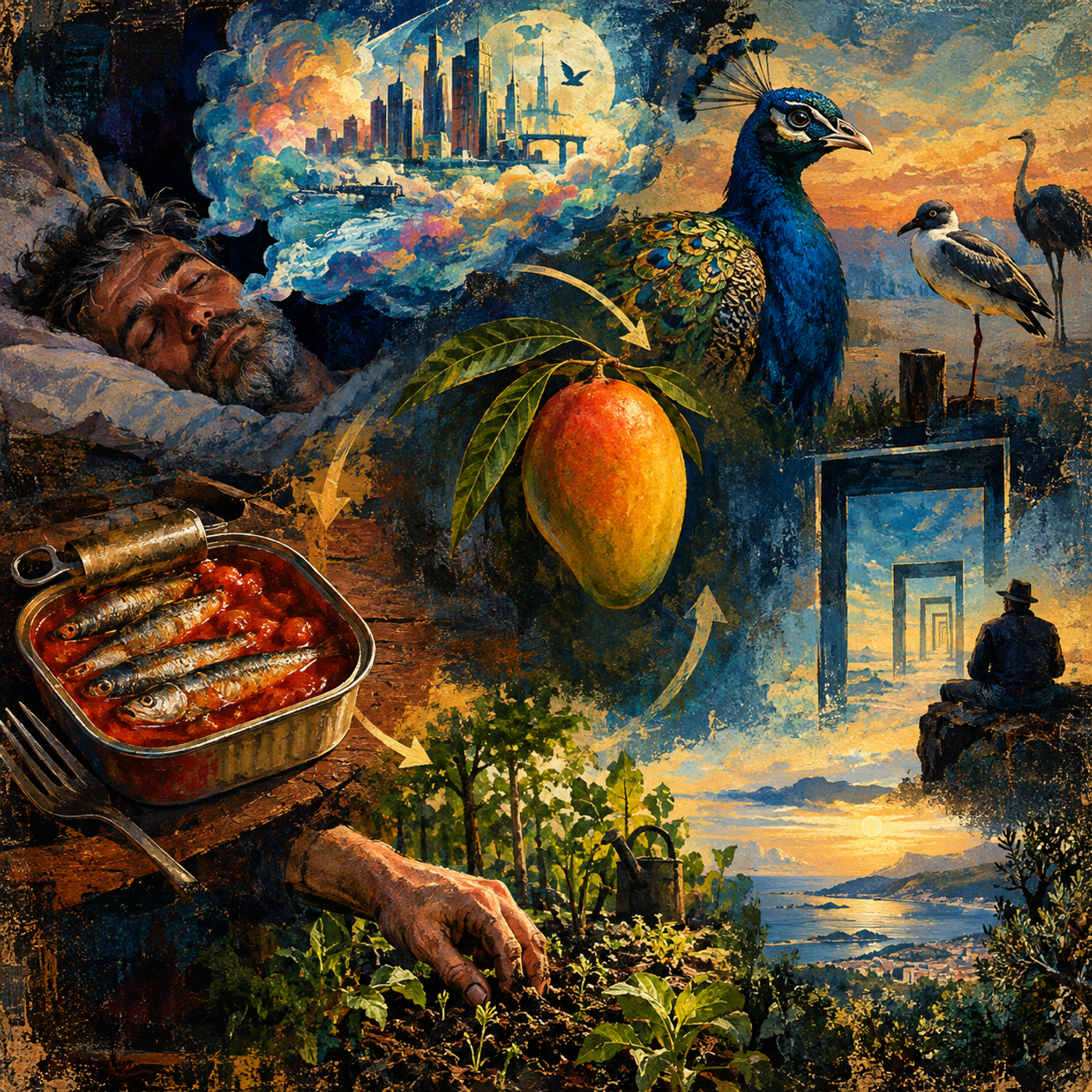
I woke up at quarter to two with a name in my head: Next Fool City. Some guy in the dream was pitching it as a product line, very earnest about it, and I came awake still hearing the pitch. I looked it up before I’d even sat up all the way. Nothing. No company, no product, no domain. So I bought the domain. I take dreams seriously enough to spend eleven dollars on one before coffee.
That’s not a quirky habit I’m reporting on. It’s the clearest window I’ve got into how the rest of the work happens, and lately I’ve been able to see the machinery a little better than usual. Three things keep showing up in what I make — birds, a mango, and dreams — and for a while I thought that was just a taste, the kind of thing a writer collects without asking why. It isn’t a taste. It’s a description of a process, and once I saw the process I found a fourth piece hiding in it that doesn’t have an image at all, just a verb.
Start with the dream, because it’s first, or at least it’s the one with no edges. A dream doesn’t hand you a single thing to consider — it floods. Most of what comes through in a night’s sleep is gone by the scrambled eggs, on purpose. If all of it stuck, there’d be no way to function. No idea why one does, and not forty other fragments from the same night.
That’s the milieu doing its task, producing more than can possibly be used, on purpose or not. It doesn’t seem to care what happens downstream with the surplus.
What’s downstream first is a watcher. In the fiction it’s Stubs, one-legged on his dish, or Jean-Paul the taxidermied peacock. In the music it’s an ostrich that wasn’t even supposed to be part of an album cover until the image generator put her there and I decided to keep her. Birds, always birds, and they’ve been watchers a lot longer than I’ve been using them.
Their job is not to judge what they see. Jean-Paul the taxidermied peacock doesn’t rank a sunset above a chemical spill. He just notices deviation, He notices a loss faster and harder than he notices an equivalent gain. Not poetic license, that’s just how attention is built, in risk managers, poets, soccer players, the rest of us. Ask anyone who’s watched a portfolio: four good days won’t register the way one bad one does.
The watcher hands you a wide, curated field of what’s different from what you expected. It curates because reality is bigger than the brain. But the bird generally doesn’t tell you which parts of that field are supposed to matter to you.
That’s the mango’s job. The mango is a threshold, not a destination. What happens at that threshold is a choice, a value system. Grow tomatoes, watch porn - your call. And if you already know which one matters more, and you do, it’s because you’ve stood at this threshold before, many times, and every earlier choice left something behind that’s still sitting there when the next one shows up. The mango doesn’t invent value out of nothing. It spends a balance that’s already been built, one way or the other.
I wrote a note a while back, half a joke, about the unspeakable indignity of being born a free sardine and ending up crowded into a small can of tomato sauce, written, for what it’s worth, while I was actually eating a tin of them. The indignity was never that the sardine got eaten. Getting eaten is generally what happens to a fish, one way or another. The indignity is being measured for a purpose that had nothing to do with anything you actually were.
We become what we measure. And we don’t become what we ignore. But the choosing is a loop, not a pipe. Keep noticing the tomatoes and the watcher starts surfacing more tomato-shaped reality. Keep noticing the darkness and the world gets darker.
People have said some version of this for a long time in language I’d normally be suspicious of — mind is a mirror, what you believe is what you receive. I used to hear that as wishful thinking. Now they are lyrics in my songs. It isn’t wishful. It’s a description of a system training itself on its own output. What you feed it is what it starts bringing you.
Here’s the part that took me longest to see, because it isn’t a noun and I kept looking for one. None of the three — the dream, the bird, the mango — explains why the same choice keeps getting made on the four-thousandth day the way it got made on the first, in a system where the watcher is built to weight the loud and the losing far more than the quiet and the working.
A single choice doesn’t survive that pressure by accident. Something has to keep choosing the same direction on purpose, long after the choosing has stopped being interesting. You just keep showing up.
I grew a garden for years in my home country. When I landed somewhere I’d never lived, I found a place where I could garden. Not because the new land cared. But because garden is a verb I run.
None of this explains the fiction or the music. It more describes the terms they operate under. I’m suspicious of anyone, myself included, who claims to have cracked their own code. I haven’t.
I don’t know why this particular cluster of images is the one my own watcher keeps bringing me. But the pattern holds wherever I go looking for it now. Dreams flood. Birds notice. The mango decides. And somebody keeps showing up to make some semblance of sense from it.