Edna Rollins Kite never did remarry. Some women wear widowhood like a Sunday hat. Edna wore hers like a locked door.
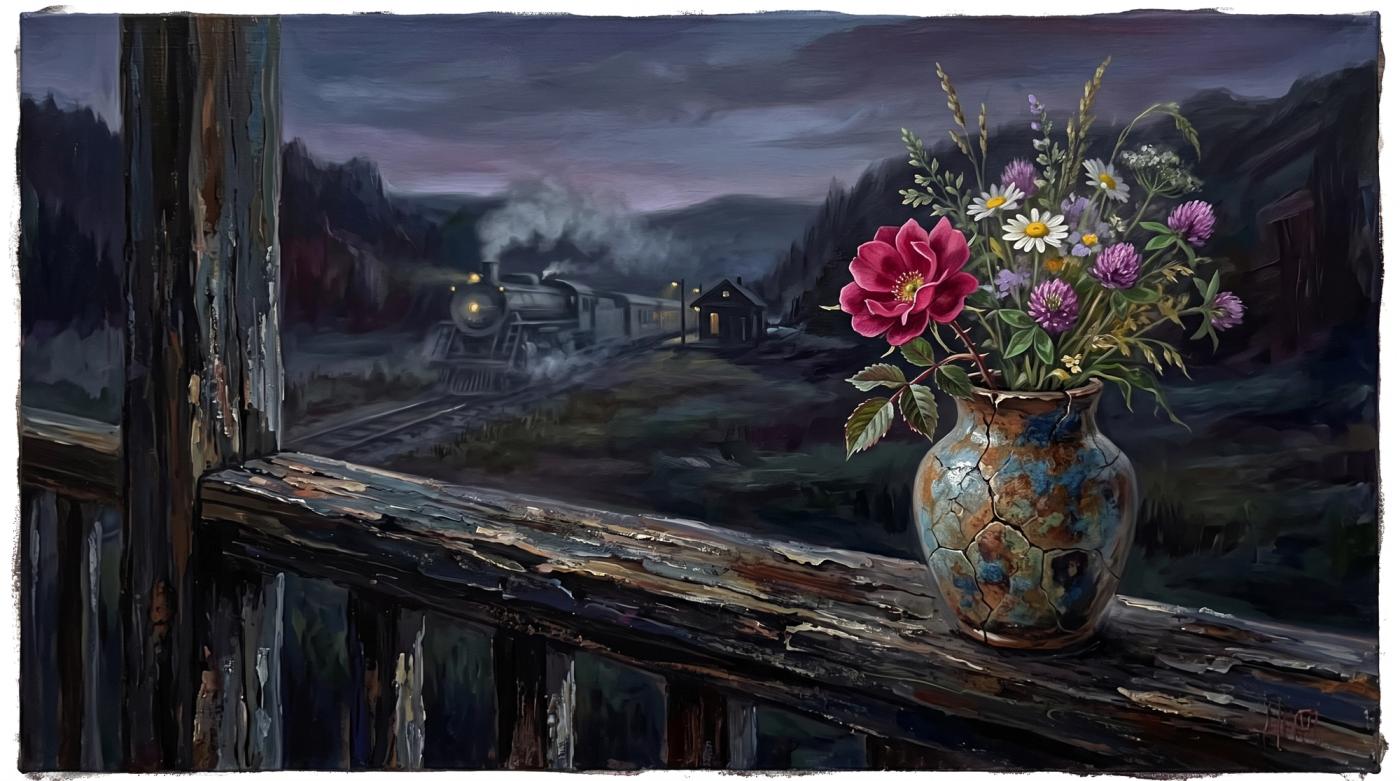
She kept the house on Sycamore Hollow Road exactly as it had been the day they carried Tom home in a box too light for a grown man. Same lace curtains, yellowed now. Same walnut bedstead with the carved pinecones. Same cracked vase on the porch rail that somehow survived. filled every Wednesday with flowers by an unknown hand. Not unknown to Edna.
Folks said Edna Kite made the best peach pie in Destiny. She’d set a pie on the windowsill to cool and the smell would drift down the hollow like a delicious promise. You took a slice, you nodded, you said thank you ma’am, and you never asked why her eyes stayed fixed on the ridge line while she cut.
She taught piano to half the children in town, thirty minutes every Tuesday and Thursday after school. Little fingers stumbling over “Amazing Grace” and “Für Elise,” and Edna correcting them, gentle, patient as the lie she lives with. After the the lesson, she’d give the child a butterscotch from a jar that was always full. She’d watch them walk down the drive. Count their steps.
Wednesdays belonged to Tom. Every single one.
Around four o’clock she’d put on the same blue dress she’d worn on their honeymoon—faded now, hem let out twice—and she’d walk to the backyard where the honeysuckle grew wild over what used to be a clothesline. She’d pick a handful of whatever was blooming (black-eyed Susans in summer, bittersweet in fall, pine boughs in winter when nothing else would do), wrap the stems in a damp dish-towel, and set the bouquet in that vase on the rail.
Then she’d sit in the porch rocker with a cup of tea gone cold and wait.
Most Wednesdays nothing happened that anybody else could see. The vase just held wet flowers until they wilted and she carried them to the burn barrel out back. But some Wednesdays—usually when the sky pressed low and gray—new flowers appeared, exotic, from somewhere else. fresh picked. Folks wandering by swore the porch light flickered like an old bulb from decades ago.
The older folks remembered the honeymoon. Tom Kite had been a deacon’s boy, big smile, bigger plans. Edna’s people thought he was steady.
Edna thought Herbert Trace was steady, had him ready to marry. But Herbert lit out with Ella Mae Sears the week before the wedding. Nobody ever spoke his name around Edna again.
So Edna married Tom because that’s what you did when the invitations were already printed and your daddy’s heart was acting up.
They took a week at Topaway Falls, a little cabin somebody’s cousin rented to honeymooners. Tom wanted to fish. Edna wanted to forget Herbert’s laugh. On the third morning Tom went out early to the overlook, said he’d get a picture of the sunrise for her scrapbook. Edna followed a minute later with coffee.
What happened next depends on who’s telling it and how much they’ve had to drink.
Some say Tom leaned too far over the rail and the rock gave way.
Some say Edna’s hand was on his back when he leaned.
Some say she screamed.
Some say the scream came after the splash, not before.
All anybody knows for sure is the body came down the falls in pieces, and Edna walked back to the cabin, sat on the porch steps, and drank both cups of coffee before the ranger arrived.
She never cried in public. Not once. Not at the funeral, not when the church ladies brought casseroles, not when the insurance man asked questions she answered in a voice flat as creek ice.
But every Wednesday since 1962, Tom comes home with flowers.
He don’t speak. He just stands at the bottom of the steps in the same plaid shirt he wore the morning he fell, soaked through, hair plastered to his forehead like he’s been underwater the whole time. He lays the bouquet gentle in the vase—always the exact same number of stems Edna picked that morning—and then he waits. Sometimes five minutes. Sometimes an hour. Long enough for her to see him clear.
Edna never invites him in. She just rocks, slow, and watches until the shape of him starts to fray at the edges like wet paper. Then he tips his hat—the one they never found—and walks back toward the river. By the time he reaches the honeysuckle he’s gone, but the flowers stay fresh another day.
She’s eighty-three now. Hands knotted with arthritis, but she still plays “Nearer My God to Thee” without missing a note. Still bakes peach pie when somebody dies. Still sets out the vase every Wednesday like clockwork.
And every Wednesday, Tom rides the 4:12 into town, brings her flowers. He don’t ask forgiveness. She don’t offer it. Some doors don’t close right. In Destiny, love is another kind of haunting.
Herbert Trace never did come back to Destiny, not in the flesh, anyway.
He left the three nights before his proposed wedding. Ella Mae Sears rode shotgun in a ’55 Chevy the color of a new melon. Morgantown, then Pittsburgh, then wherever the road quit asking questions. Ella Mae had a cousin in the mills, and Herbert had a guitar and a voice that could make a woman forget her own name. That was all it took back then.
They made it as far as Wheeling before the money ran thin and the arguments ran thick. Ella Mae wanted bright lights; Herbert wanted quiet bars where nobody knew his last name. By Christmas she was gone—caught a Greyhound with a truck driver who promised Florida—and Herbert was alone in a rented room above a pool hall that smelled of stale beer and broken promises.
He played guitar in roadhouses for tips and drinks, slept in the Chevy when the rent came due, and wrote songs nobody ever recorded. Pretty things about rivers and leaving and girls with dark hair who pushed men off cliffs. He never sang them in Destiny, but somehow the words drifted back anyway, carried on truck-stop radios and the mouths of men passing through.
Years turned into decades. The hair went gray, the fingers stiffened, the voice roughened into something that sounded like gravel soaked in bourbon. He bounced from Ohio to Tennessee to the Carolinas, always one step ahead of whatever was chasing him. Never married. Never stayed long enough for roots.
In ’89 he landed in a little nothing town outside Asheville called Sugar Cove. Took a job tuning pianos in a music store and lived in a trailer behind the VFW. Quiet life. Played old country on Friday nights for beer and applause that didn’t ask questions.
That’s where the 4:12 finally caught him.
It was a Wednesday, of course. Herbert was walking home from the store with a bottle in a paper sack when he heard the whistle—low, familiar, like a hymn he’d forgotten the words to. He hadn’t heard a train in years; the nearest track was twenty miles away. But there it was, sliding out of the pines like it had always been there.
The doors opened.
He knew before he saw her.
Edna stood in the aisle wearing the blue dress, older now, hair gone silver, eyes still sharp enough to cut. She didn’t speak. Just looked at him the way she had the night he left—like he was something she’d already buried.
Behind her sat Tom Kite, soaked to the bone, holding a handful of wilted flowers.
Herbert got on. Didn’t mean to. His feet just carried him up the steps like they’d been waiting forty years for the right schedule.
The train didn’t go far. Just circled the ridge once, slow, like it was giving him time to look out the window at the life he’d run from. Destiny rolled past in pieces: the store, the church, the falls, the porch with the vase that never quite emptied.
Edna sat across from him the whole ride. Tom stood in the back, dripping on the floor.
When the train stopped—same cracked platform, same rusted bench—Herbert tried to stand. Couldn’t. His legs wouldn’t move. Edna reached across the aisle and touched his hand, just once. Cold as creek water.
The doors opened again.
Tom stepped off first, flowers in hand.
Edna followed.
Herbert stayed seated.
The train pulled away, slow and steady, into the dark between the ridges. He rides it still, every Wednesday, guitar across his knee, playing songs nobody down below ever gets to hear. Sometimes folks in Sugar Cove swear they catch a strain of music on the wind—old Hank Williams stuff, or something sadder that don’t have a name.
And every Wednesday in Destiny, when Edna sets out her vase, there’s an extra bloom in the bouquet. A single wild rose, fresh as the day he left, thorn still sharp.
She never throws it away. Some debts don’t die with the debtor. In the end, the 4:12 always brings them home.